Private Orthopaedic Surgery Options for Canadians

Rethinking Healthcare in Canada
Moving Beyond the Public vs. Private Debate
Anthony J. Costa, MD, FRCSC | Orthopaedic Surgeon | Ortho SouthCanadian healthcare debates have become remarkably predictable. One side argues that public delivery must be protected; the other argues that private participation is necessary to improve access. The discussion often becomes a contest between labels rather than an examination of what patients and healthcare professionals actually need.
The more useful question is not whether healthcare should be public or private. It is how to design a healthcare system that consistently delivers high-quality care, measures its performance honestly, and uses available resources responsibly.
Countries such as Australia, Germany, France, the Netherlands and Switzerland have organized universal healthcare around different combinations of public financing, regulated insurance, and independent delivery. These arrangements are not interchangeable, and none provides a ready-made Canadian solution. They do demonstrate, however, that universal access and a role for independent providers are not mutually exclusive.
Canada itself already accepts mixed financing and delivery in large areas of healthcare, including prescription drugs, dentistry, physiotherapy, psychology and other services. The restrictions surrounding insured physician and hospital services are therefore a particular policy choice, not an inevitable feature of universal healthcare. We should be willing to examine whether those boundaries produce the outcomes we intend.
What does quality healthcare actually mean?
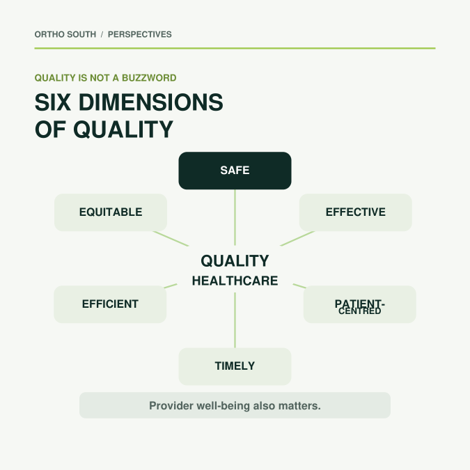
Quality is invoked constantly in healthcare policy, yet rarely defined. The Institute of Medicine identified six widely used dimensions of quality: care should be safe, effective, patient-centred, timely, efficient and equitable. Each describes something important, and none can substitute for the others. [1]
A procedure may be technically excellent but delivered after a debilitating wait. Care may be timely but poorly coordinated. A service may be efficient from a hospital’s perspective while imposing substantial travel, recovery or financial burdens on patients. Improving one measure while neglecting the others is not necessarily improving the system.
The Institute for Healthcare Improvement’s Triple Aim emphasizes patient experience, population health and per-capita cost. The Quadruple Aim adds the experience and well-being of healthcare providers. That addition matters. A system that achieves short-term output by exhausting its workforce is not sustainable, and provider well-being should not be dismissed as separate from quality. [2,3]
Improving one dimension does not necessarily improve overall quality
An important consequence of viewing healthcare quality as a multidimensional concept is recognizing that improvements in one dimension do not necessarily translate into improvements in overall quality. Healthcare policy frequently focuses on individual performance indicators, such as surgical waiting times, procedural volumes, or operating room utilization. While these are important measures, they cannot independently establish whether a healthcare system is delivering better care.
Consider centralized surgical wait lists and first-available-surgeon models. Distributing referrals across available surgeons may improve timeliness and the utilization of existing resources. However, depending on how such programs are designed, they may also affect patient choice, continuity of care, access to subspecialty expertise, and potentially clinical outcomes. Differences in surgeon experience, facility capabilities, and patient circumstances must be considered. A system that reduces waiting times while limiting patient choice or introducing additional costs and administrative complexity may represent an improvement in one dimension of quality without necessarily improving overall quality or value. Conversely, a well-designed centralized referral system could improve timeliness and equity while preserving meaningful patient choice.
The same principle applies to surgical throughput. Increasing the number of procedures performed is not inherently evidence of improved healthcare quality or efficiency. If increased volume is accompanied by higher complication rates, poorer functional outcomes, or greater downstream costs, the apparent gains may be offset or even reversed. The objective should not be to maximize individual performance metrics, but to improve the overall quality and value of care delivered.
A meaningful evaluation must therefore consider clinical outcomes and safety, access and timeliness, the experience of patients and families, equity, efficiency, and the conditions in which healthcare professionals deliver care. Those dimensions should be measured, not merely asserted.
Understanding quality, cost and value
A useful conceptual way to frame healthcare value is:
VALUE = QUALITY / COST
This is a framework, not a literal or perfectly linear equation. Quality is multidimensional, costs can be difficult to allocate, and different benefits matter differently to different people. Nevertheless, the relationship is useful. If quality remains unchanged while cost rises, value generally falls. If quality improves without additional cost, value generally rises. When both quality and cost increase, we must ask whether the additional benefit is worth the additional expenditure. [4]
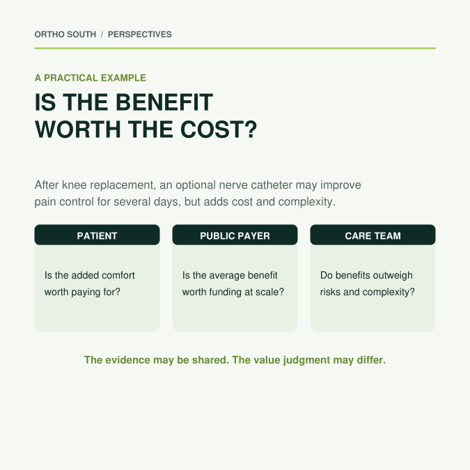
There is another complication: value depends partly on perspective. A public administrator must consider opportunity cost across a population. A patient may place a high value on a particular improvement in comfort or function. A surgeon may consider clinical benefit, safety and workflow. A facility must consider staffing, infrastructure and sustainability. The evidence describing an intervention does not necessarily change between these perspectives, but the judgments about its value can.
Consider postoperative pain management after knee replacement. A continuous peripheral nerve catheter can extend regional analgesia, but whether it provides a clinically important advantage over a single-injection block or other multimodal strategies remains debated in systematic reviews. [8,9] It also requires equipment, staff time, follow-up and expenditure. An individual patient paying privately might reasonably value a possible improvement in early comfort enough to purchase that option. A publicly funded program might conclude that the average incremental benefit does not justify routine funding across thousands of procedures. A care team must also weigh the evidence, patient selection, risks and logistical implications. Availability and practice vary; the example is not a claim that catheters are never offered in public hospitals.
Neither conclusion is automatically irrational. A patient’s willingness to pay does not establish clinical effectiveness, and a public payer’s decision not to fund something does not establish that the intervention has no value. We should distinguish what society chooses to fund universally from what an informed patient may be permitted to purchase, while also taking equity and system effects seriously.

The arguments against independent healthcare delivery deserve closer examination
“Private facilities cost more.”
Sometimes they do. But the comparison is frequently less straightforward than it appears. A quoted hospital cost per case may omit capital construction, equipment replacement, financing, shared infrastructure or overhead carried elsewhere in a health authority’s budget. Conversely, a new independent facility must recover its full costs through its operating model.
Comparing the marginal cost of adding one operation to an existing hospital with the full cost of building and operating additional capacity is not an apples-to-apples comparison. A fair analysis should account for the complete costs of each model, including staffing, implants, administration, financing, infrastructure and risk. It should also recognize that public hospitals provide emergency, teaching and complex-care services that an elective surgical centre may not.
The cost of waiting also matters. Delayed treatment may impose pain, lost mobility, prolonged disability, lost income, caregiver demands and additional healthcare utilization. Those costs are real even when they do not appear on the hospital’s surgical balance sheet. The relevant question is not simply which facility posts the lowest procedure price, but which configuration produces the best outcomes and overall value. [5]
“Private healthcare fragments care.”
Fragmentation is a legitimate concern, but ownership alone does not determine whether care is coordinated. A patient can experience multiple referrals, disconnected imaging, separate waiting lists and uncertain follow-up entirely within a publicly funded system. An independent program can be organized around a coordinated pathway from consultation and investigation through surgery, rehabilitation and postoperative care.
The reverse can also be true. An independent provider that fails to communicate with primary care, hospitals or emergency services can create serious gaps. The appropriate standard is continuity, accountability, clear clinical responsibility and interoperable communication—not a presumption that one ownership model is inherently integrated.
“Private facilities take healthcare workers away from public hospitals.”
Workforce displacement is a genuine risk, particularly during transitions when staffing is already tight. It cannot be waved away. But treating the workforce as a fixed pool that must remain in one employment setting overlooks why professionals leave, reduce hours or abandon clinical work.
Compensation matters, but so do scheduling, staffing ratios, leadership, workplace culture, autonomy, moral distress and burnout. Healthcare is not a factory, and clinicians cannot indefinitely compensate for organizational shortcomings through personal sacrifice. Better working conditions in any setting may help retain professionals who would otherwise reduce their participation or leave the workforce altogether. [6]
The effect of independent capacity on the public workforce should therefore be measured rather than assumed. We need to examine where staff come from, whether total hours of care increase, what happens to public services, and whether both sectors improve retention and working conditions.
“Private facilities select straightforward patients, leaving complex cases behind.”
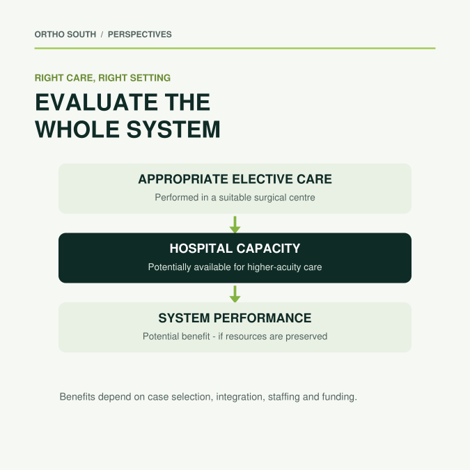
Case selection is a defining feature of many ambulatory surgical programs. It can also be an appropriate form of clinical organization. Patients who can safely undergo planned procedures in a specialized facility may not need the full infrastructure of an acute-care hospital. Moving suitable elective cases out of hospitals could preserve operating rooms, inpatient beds and multidisciplinary resources for patients with greater medical complexity or urgent needs.
That benefit is not automatic. It depends on appropriate clinical selection, clear transfer arrangements, maintained hospital resources and whether freed capacity is actually redirected to patients who need it. Facilities should be accredited and evaluated according to their capabilities. Clinical complexity limits should follow evidence, staffing and infrastructure rather than assumptions about ownership.
We need to evaluate the entire system
Healthcare systems are interconnected. A decision that appears to save money within one department may increase costs elsewhere. A change that increases the apparent cost of an individual operation may reduce waiting-related disability or improve access to more complex hospital care. An intervention that increases surgical volume may still be a poor reform if it worsens safety, equity or workforce sustainability.
Consider the potential pathway when appropriately selected elective surgery moves to a dedicated surgical centre. Hospital operating rooms and beds may become available for higher-acuity work. But whether this improves overall performance depends on staffing, funding, patient selection, transfers and how hospitals use the released capacity. We should measure those downstream effects rather than assume them.
The status quo also deserves scrutiny. Maintaining existing arrangements is a policy choice with consequences, including the consequences of delayed access and constrained capacity. Proposed reforms should be held to rigorous standards—but so should the arrangements they seek to change.
Evaluation should follow patients across the entire care pathway and examine clinical outcomes, complications, access, wait times, continuity, patient and provider experience, equity, workforce effects and full system costs. It should account for transitions and unintended consequences. A facility’s financial performance is not the same as the performance of the healthcare system.
Learning from other healthcare systems
International comparisons are useful when approached carefully. Universal coverage can coexist with different mixes of public provision, private delivery and regulated financing. That does not mean that introducing private facilities automatically improves care, nor does it mean that a model successful elsewhere can simply be imported into Canada. [7]
Countries differ in workforce supply, regulation, insurance design, population needs and political choices. The appropriate lesson is to study which arrangements achieve measurable outcomes, understand the conditions that support them, and adapt cautiously. Any reform should be evaluated over time, including its transition costs, distributional effects and consequences for public services.
Moving beyond the public–private debate
We should separate three questions that are too often conflated: who finances care, who delivers care, and whether the care is good. Public funding does not by itself guarantee quality. Independent delivery does not by itself guarantee efficiency or better outcomes. Both should be judged against transparent, meaningful standards.
Before debating ownership, we should agree on what quality means, how it will be measured, what costs count, whose perspectives matter and what trade-offs are acceptable. We should be willing to fund effective care, reject ineffective care, protect equitable access, support healthcare professionals and change delivery arrangements when evidence supports doing so.
The goal should not be more public healthcare or more private healthcare.
The goal should be better healthcare.
That requires us to assess quality across all its dimensions, understand full costs and evaluate value at the level of the whole system. It also requires an honest discussion about what we can measure, what we choose to fund and how different delivery arrangements can contribute to the same objective.
A Note on Perspective
I am an orthopaedic surgeon who has worked in publicly funded and independent surgical settings. Many examples in this article come from elective surgical care, where differences in access, care pathways, infrastructure and funding are particularly visible. Family physicians, nurses, other specialists, allied health professionals and patients working in different areas of healthcare may encounter different priorities and constraints. The broader framework—safe, effective, patient-centred, timely, efficient and equitable care, supported by a sustainable workforce and evaluated against its full cost—should nevertheless apply across healthcare.
References
- Institute of Medicine. Crossing the Quality Chasm: A New Health System for the 21st Century. National Academies Press; 2001.
- Berwick DM, Nolan TW, Whittington J. The Triple Aim: care, health, and cost. Health Affairs. 2008;27(3):759–769. doi:10.1377/hlthaff.27.3.759.
- Bodenheimer T, Sinsky C. From Triple to Quadruple Aim: care of the patient requires care of the provider. Annals of Family Medicine. 2014;12(6):573–576. doi:10.1370/afm.1713.
- Porter ME. What is value in health care? New England Journal of Medicine. 2010;363:2477–2481. doi:10.1056/NEJMp1011024.
- OECD. Health at a Glance 2025: OECD Indicators. OECD Publishing; 2025. Section: Waiting times. doi:10.1787/8f9e3f98-en.
- Hodkinson A, et al. Associations of physician burnout with career engagement and quality of patient care: systematic review and meta-analysis. BMJ. 2022;378:e070442. doi:10.1136/bmj-2022-070442.
- OECD. Health at a Glance 2025: OECD Indicators. OECD Publishing; 2025. doi:10.1787/8f9e3f98-en.
- Sercia QP, Bergeron JJ, Pelet S, Belzile EL. Continuous vs. single-shot adductor canal block for pain management following primary total knee arthroplasty: a systematic review and meta-analysis of randomized controlled trials. Orthopaedics & Traumatology: Surgery & Research. 2022;108(8):103290. doi:10.1016/j.otsr.2022.103290.
- Hussain N, et al. Analgesic benefits of single-shot versus continuous adductor canal block for total knee arthroplasty: a systematic review and meta-analysis of randomized trials. Regional Anesthesia and Pain Medicine. 2023;48(2):49–60. doi:10.1136/rapm-2022-103756.
Acknowledgements
I am grateful to the faculty and my fellow surgeons in Harvard Medical School’s Surgical Leadership Program for helping shape my thinking about healthcare quality, value and leadership. The views expressed here are my own and do not represent the position or endorsement of Harvard Medical School.
Questions About Our Services?
Contact our team to learn more about consultations, surgical procedures, locations, pricing, or appointment availability.